
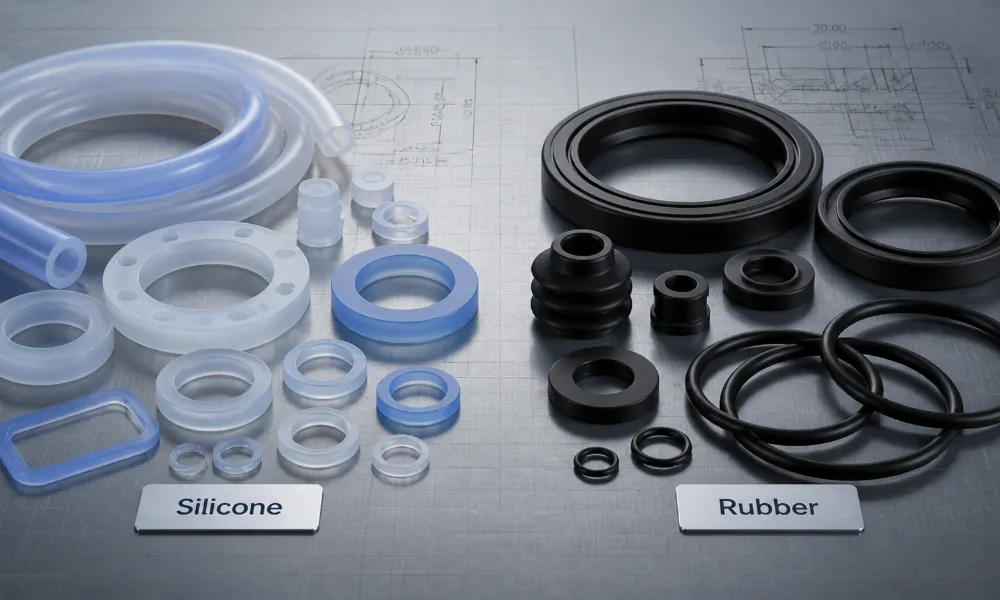
Choosing between silicone vs rubber is one of the most common material decisions you will face when designing seals, gaskets, tubing, or molded components. Both are elastomers. Both flex, stretch, and compress. But the way each performs under heat, chemicals, mechanical stress, and regulatory scrutiny can be dramatically different.
The right choice depends not on which material is “better” in a general sense, but on which one matches the specific temperature range, chemical exposure, compliance requirements, and mechanical demands of your product environment. A silicone gasket that excels in a medical steam sterilizer will fail quickly in an oil-filled hydraulic system. A nitrile rubber seal that thrives against fuels and lubricants will crack and degrade under prolonged UV exposure.
This guide breaks down the real performance differences between silicone and the major rubber families, including NBR, EPDM, neoprene, SBR, and FKM. You will find practical, application-led guidance so you can match the right material to the right job.
How the Two Materials Differ
Silicone and rubber are both classified as elastomers, but their molecular backbones, raw material origins, and performance envelopes are fundamentally different. A polysiloxane chain behaves nothing like a carbon-based isoprene or styrene-butadiene chain when exposed to heat, UV light, or aggressive fluids.
What Silicone Is and How Polysiloxane Structure Changes Performance
Silicone is a synthetic elastomer built on a silicon-oxygen backbone called polysiloxane. This inorganic structure is derived from silica, not petroleum. The silicon-oxygen bond is what gives silicone its standout traits: exceptional thermal stability, strong UV and ozone resistance, and inherent chemical inertness.
In practice, silicone rubber maintains flexibility across a wide temperature window, typically from around -60°C to +230°C, with specialty grades reaching even higher. It resists degradation from sunlight, weather, and ozone without requiring added stabilizers. It is also naturally low in toxicity and does not support microbial growth, which is why it dominates food-contact and medical applications.
The tradeoff is lower tensile strength and tear resistance compared to most organic rubbers. Silicone also struggles against oils, fuels, and many solvents.
What Rubber Means Across Natural and Synthetic Families
When you hear “rubber,” the term covers a broad family of materials. Natural rubber is harvested from latex (polyisoprene) and offers excellent elasticity and tensile strength. Synthetic rubbers are polymerized from petroleum-based monomers and engineered for specific exposures.
Key synthetic families include:
- SBR (styrene-butadiene rubber): General-purpose, widely used in tires and footwear.
- NBR (nitrile rubber): Excellent oil and fuel resistance for automotive and industrial seals.
- EPDM (ethylene propylene diene monomer): Strong UV, ozone, and steam resistance for outdoor and roofing applications.
- Neoprene (CR): Balanced weather, flame, and chemical resistance.
- FKM (Viton): Premium fluoroelastomer for extreme heat and aggressive chemical environments.
Each synthetic rubber has a distinct performance profile, so “rubber” is never a single answer.
Why Similar Feel Does Not Mean Similar Material Behavior
Silicone and rubber feel remarkably alike in your hand. Both are soft, flexible, and slightly grippy. This tactile similarity leads many buyers and even some engineers to treat them as interchangeable. They are not.
A silicone O-ring and a nitrile O-ring may look identical on a shelf, but one will swell and fail in contact with hydraulic oil while the other will handle it without issue. Product labels sometimes compound this confusion by calling silicone a “synthetic rubber,” which is technically accurate but obscures the performance gap. Always select based on tested material properties, not appearance or general category names.
Performance Factors That Drive Material Choice
Temperature range, chemical compatibility, mechanical strength, and electrical behavior are the core criteria that separate silicone from the various rubber families. The sections below address each factor with the specific data points you need to make a sound material decision.
Heat, Cold, and Thermal Cycling
Silicone handles sustained high heat better than nearly every general-purpose rubber. Standard silicone compounds remain stable up to approximately 230°C, while most organic rubbers begin to harden, crack, or lose elasticity above 120°C to 150°C. FKM is the notable exception on the rubber side, handling continuous service up to around 200°C.
On the cold end, silicone also leads. It stays flexible down to roughly -60°C, whereas many rubbers stiffen below -30°C. EPDM performs reasonably well in cold but still cannot match silicone at extreme low temperatures.
For applications involving repeated thermal cycling, silicone’s inorganic backbone resists oxidative aging far better than carbon-based rubbers, which tend to develop surface cracking over time.
Chemical Exposure, Oil Contact, and Fluid Compatibility
This is where rubber families often outperform silicone. Silicone has poor resistance to oils, fuels, hydrocarbon solvents, and concentrated acids. In contact with these substances, silicone swells, softens, and loses structural integrity.
NBR is the standard choice for petroleum oils and fuels. FKM handles aggressive chemicals, acids, and high-temperature fluids. Neoprene offers moderate resistance to a broad range of chemicals plus decent flame resistance. EPDM excels in water, steam, and many polar solvents but fails against petroleum-based fluids.
If your product environment involves oil, fuel, or harsh solvents, a rubber compound will nearly always be the safer pick.
Strength, Wear, Sealing, and Electrical Performance
Rubber generally delivers higher tensile strength, better tear resistance, and greater abrasion resistance than silicone. For parts under constant mechanical load, such as conveyor belts, engine mounts, or vibration dampers, organic rubbers are preferred.
Silicone, on the other hand, offers lower compression set in high-heat environments, meaning it maintains seal force more reliably under sustained elevated temperatures. It also provides excellent electrical insulation and high dielectric strength, making it a strong fit for wire insulation, connector seals, and electrical enclosures.
For weather resistance and ozone resistance specifically, silicone and EPDM both perform well. Most other rubbers require antiozonant additives for outdoor service.
| Property | Silicone | NBR | EPDM | Neoprene | FKM |
| Heat resistance | Excellent | Moderate | Good | Moderate | Excellent |
| Cold flexibility | Excellent | Good | Good | Moderate | Moderate |
| Oil resistance | Poor | Excellent | Poor | Moderate | Excellent |
| Tensile strength | Low | High | Moderate | Moderate | Moderate |
| Abrasion resistance | Low | High | Moderate | Moderate | Moderate |
| UV/ozone resistance | Excellent | Poor | Excellent | Good | Good |
| Electrical insulation | Excellent | Moderate | Good | Moderate | Good |
| Biocompatibility | Excellent | Poor | Poor | Poor | Moderate |
Best Material by Product Environment and Use Case
Matching material to application is more productive than ranking materials in the abstract. The decision always comes back to operating conditions: temperature, fluid contact, regulatory requirements, mechanical loads, and budget.
When Silicone Is the Better Fit
Choose silicone when your product environment demands one or more of the following:
- Sustained high or low temperatures: Silicone gaskets and seals in ovens, autoclaves, and cryogenic equipment maintain flexibility and seal integrity across extreme thermal ranges.
- Food contact and FDA compliance: Silicone is available in FDA-compliant and USP Class VI grades, making it the go-to material for food processing seals, baking molds, and beverage dispensing components.
- Medical and pharmaceutical use: Medical tubing, implantable components, and cleanroom seals rely on silicone’s biocompatibility, sterilizability, and low extractables.
- Outdoor and UV exposure without mechanical load: Silicone resists ozone and UV degradation without additives, making it a strong option for outdoor lighting gaskets and weather seals.
- Electrical insulation: Silicone’s high dielectric strength suits wire insulation, connector boots, and high-voltage shielding.
When Rubber Grades Are the Better Fit
Rubber families win when your application involves significant mechanical stress, fluid contact with oils or fuels, or tight cost constraints.
- NBR (nitrile rubber): Fuel system seals, hydraulic O-rings, and any component in direct contact with petroleum-based fluids.
- EPDM rubber: Coolant hoses, roofing membranes, steam gaskets, and brake fluid seals. Its water and steam resistance is excellent.
- Neoprene rubber: Industrial gaskets needing balanced chemical and flame resistance, plus moderate weather exposure.
- SBR: Cost-driven, general-purpose parts like conveyor belts and shoe soles where extreme conditions are not a factor.
- FKM (Viton): Aggressive chemical environments, high-temperature fuel systems, and semiconductor processing seals where nothing else holds up.
Common Product Examples and Tradeoffs
Specific product decisions often come down to weighing two or three competing factors.
- Silicone tubing vs. rubber tubing: Silicone tubing is preferred for medical and food-grade fluid transfer because of its purity and flexibility. For oil or solvent transfer, NBR or FKM tubing is required.
- Silicone gaskets vs. rubber gaskets: Silicone gaskets excel in high-heat flanges and food equipment. Industrial gaskets exposed to oils and fuels perform better in NBR or FKM.
- Engine mounts and vibration dampers: Natural rubber and SBR provide the high tensile strength and energy absorption these parts need. Silicone would tear under the same mechanical load.
- Coolant hoses: EPDM rubber is the standard because of its resistance to glycol-based coolants and sustained moderate heat. Silicone coolant hoses exist in aftermarket automotive applications but cost significantly more.
In every case, the right material is the one whose strengths align with the most critical demands of your application, not the one with the longest general spec sheet.
Frequently Asked Questions
What are the key performance differences between silicone and rubber in real-world applications?
Silicone offers superior heat resistance, UV stability, and biocompatibility, while rubber families like NBR, EPDM, and FKM provide better tensile strength, abrasion resistance, and oil compatibility. The practical difference shows up most clearly in how each material ages under the specific stresses of your product’s operating environment.
How do silicone and rubber compare in temperature resistance and long-term heat aging?
Silicone maintains flexibility from approximately -60°C to +230°C, outperforming most rubbers, which typically max out around 120°C to 150°C. Over long-term heat exposure, silicone’s silicon-oxygen backbone resists oxidative aging and surface cracking far better than carbon-based rubbers, with FKM being the closest competitor on the rubber side.
Which material offers better chemical, oil, and solvent resistance for industrial environments?
Rubber families generally outperform silicone in chemical and oil resistance. NBR handles petroleum oils and fuels, FKM withstands aggressive acids and solvents, and EPDM resists water and steam. Silicone swells and degrades in contact with most oils and hydrocarbon solvents, making it a poor fit for those environments.
How do silicone and rubber differ in durability, compression set, and sealing reliability over time?
Rubber provides higher tensile and tear strength, making it more durable under mechanical load. Silicone, though softer, maintains lower compression set at elevated temperatures, meaning it holds seal pressure more consistently in hot environments. Your choice depends on whether the dominant stress is mechanical or thermal.
What are the cost, tooling, and manufacturing trade-offs when choosing between silicone and rubber?
Silicone raw material and processing costs are typically higher than those of common rubbers like NBR, EPDM, and SBR. Tooling for both is similar when using compression or injection molding. For high-volume, cost-sensitive parts without extreme environmental demands, rubber offers a clear economic advantage.
Which material is more suitable for food-contact, medical, and regulatory-compliant products?
Silicone is the standard for food-contact (FDA-compliant) and medical (USP Class VI) applications due to its biocompatibility, low toxicity, and resistance to repeated sterilization. Most organic rubbers are not inherently food-safe or biocompatible and require special compounding to meet these standards, which limits their availability and increases qualification costs.
 English
  Chinese