The most critical factors when buying wholesale silicone baby products are material certification, factory transparency, and a clear OEM/ODM workflow that scales with your business. This guide covers how to evaluate a silicone baby products factory, what safety standards and certifications matter for US and EU markets, which product lines offer the best wholesale opportunity, and how to manage customization from sampling through reorder. Every section is written with sourcing decisions in mind so you can move from research to purchase order with confidence.
How to Evaluate a Wholesale Factory Partner
Finding a reliable wholesale silicone baby products supplier starts with knowing what separates a genuine silicone baby products manufacturer from a trading company reselling someone else’s inventory. A direct factory relationship gives you better pricing, faster communication on custom orders, and more control over quality.
What to Check Before Requesting a Quote
Before sending your first inquiry, verify three things about any potential wholesale supplier:
- Factory vs. trading company status. Ask for factory photos, video tours, or third-party audit reports. A real silicone baby products factory will show injection molding equipment, mixing rooms, and QC labs.
- Certifications on file. Look for ISO 9001, BSCI, Sedex, or SA8000 on the factory level. Product-level certifications (FDA, LFGB, EN71) should be available per SKU.
- Export experience. Ask which markets they currently serve. A factory with established global shipping routes to the US will handle logistics, labeling, and customs documentation more smoothly.
I always request a company profile document and cross-reference it with public audit databases before scheduling a call.
Factory Capabilities, Audits, and Production Capacity
Production capacity matters as much as price. A factory with only a few presses may struggle to deliver large orders on time.
| Evaluation Criteria | What to Look For |
| Equipment | Liquid silicone rubber (LSR) injection machines, compression molding lines |
| Audits | BSCI, Sedex, FCCA, or Disney audit certifications |
| QC infrastructure | In-house testing lab with strict quality control protocols |
| Annual output | Ask for annual tonnage or unit capacity figures |
Factories like Jution Silicone, for example, publicize decades of production experience and hold multiple social compliance audits. That level of transparency is a strong signal for wholesale buyers.
Questions to Ask About MOQ, Lead Time, and Reliability
Every wholesale silicone baby order involves MOQ, lead time, and delivery reliability. Ask these questions early:
- What is the MOQ per SKU and per order?
- What is the standard lead time for stock molds vs. custom molds?
- Can you provide references from current US-based clients?
- What happens if a batch fails QC inspection?
Most established manufacturers set MOQs between 500 and 3,000 pieces per item, with lead times of 20 to 45 days depending on customization. Get these details in writing before committing.
Safety Standards and Material Requirements
Material safety is the single biggest compliance concern for anyone selling baby products in the US or EU. The difference between food-grade silicone and generic silicone can mean the difference between a successful product launch and a costly recall.
Food-Grade Silicone vs. Generic Silicone Materials
Not all silicone is the same. 100% food-grade silicone is made from high-purity liquid silicone rubber and is free from BPA, phthalates, PVC, and lead. Generic or industrial-grade silicone may contain fillers or plasticizers that are unsafe for infant use.
I always ask suppliers for material data sheets (SDS) and third-party test reports specific to the silicone compound used. High-quality silicone will pass migration testing, which measures whether any chemicals leach into food or saliva under realistic conditions.
A quick physical check: food-grade silicone should not have a strong chemical smell, and it should return to its original shape after being pinched or stretched.
Key Certifications for EU and US Markets
Different markets require different certifications. Here is a simplified breakdown:
| Market | Key Certifications | What They Cover |
| US | FDA 21 CFR 177.2600, CPSIA | Food contact safety, lead and phthalate limits for children’s products |
| EU | LFGB, EN71, REACH, RoHS | Food contact, toy safety, chemical restrictions |
| General | BPA-free testing, ISO 9001 | Material safety, quality management systems |
If you sell in both markets, make sure your silicone baby products manufacturer can provide documentation for each standard. Certifications should be current, not expired, and tied to the specific product SKUs you are ordering.
How Quality Control Protects Compliance and Consistency
Certifications get you into the market. Strict quality control keeps you there.
A good factory runs QC checks at three stages: incoming raw material inspection, in-process checks during molding, and final pre-shipment inspection. I recommend requesting photos and reports from each stage for your first several orders.
Third-party inspections through companies like SGS, Bureau Veritas, or Intertek add another layer of assurance. These inspections cost a few hundred dollars per order but can prevent a shipment of defective silicone products from reaching your warehouse.
Best Product Lines to Source in Bulk
Choosing the right product mix is essential for margin, inventory turnover, and catalog depth. Silicone baby feeding products remain the highest-volume category, but teething and accessory lines round out a competitive wholesale assortment.
Feeding Essentials for Core Catalog Growth
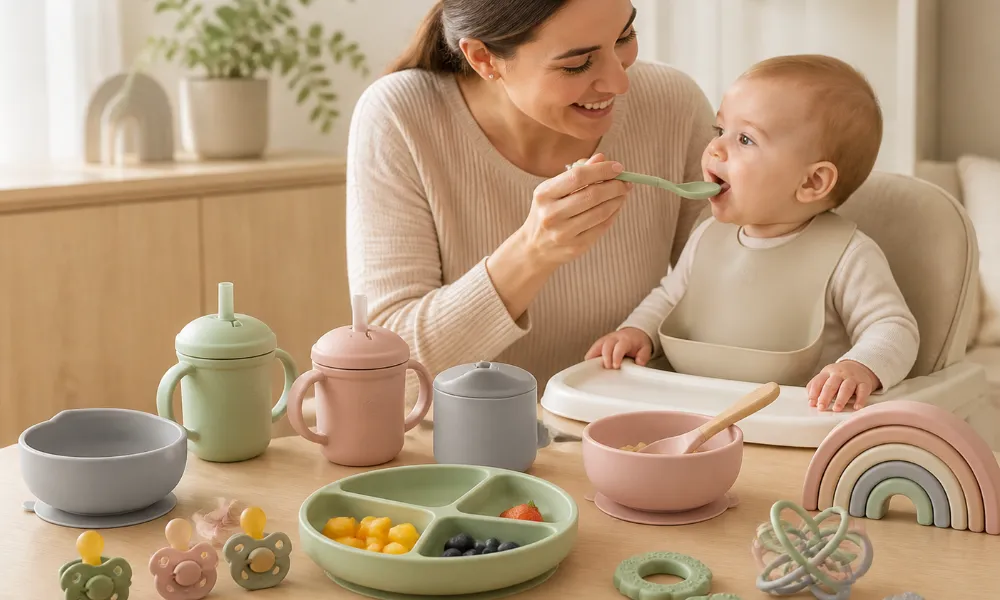
Baby feeding products are the backbone of any silicone baby products catalog. These items have consistent year-round demand and strong reorder rates.
Top-performing feeding SKUs include:
- Silicone baby bibs with food-catching pockets
- Silicone baby bowls and silicone baby plates with suction bases
- Silicone baby cups (training cups and snack cups)
- Silicone forks and spoons designed for self-feeding
- Food dispensing spoons and silicone placemats
Silicone bowls and plates with suction features are particularly popular because they solve a real problem for parents. I have found that bundling feeding items into sets increases average order value for retail buyers.
Teething, Pacifier, and Toy Categories
Teething and soothing products offer strong margins and gift-market potential.
- Silicone teethers and silicone teether beads in various shapes and textures
- Silicone pacifiers made from 100% food-grade silicone
- Silicone pacifier clips that attach to clothing or strollers
- Silicone baby toys for sensory play, stacking, and early education
- Silicone baby brush products for skin and oral care
Silicone beads and pacifier clip components also sell well to small businesses making handmade baby accessories. These items are lightweight and easy to ship.
How to Build a Balanced Wholesale Assortment
A strong wholesale assortment covers daily essentials, gifting items, and impulse-buy accessories. I recommend this ratio as a starting framework:
- 60% feeding products (bibs, bowls, plates, cups, utensils)
- 25% teething and soothing products (teethers, pacifiers, clips)
- 15% accessories and toys (silicone toys, brushes, storage)
Start with proven, high-demand SKUs in stock mold designs. Add custom or niche items once you have steady reorder volume.
Customization, Sampling, and Scaling Orders
Customization is where wholesale silicone baby products become your brand, not just generic inventory. The right silicone baby products manufacturer will support you from initial concept through scaled production and global shipping.
OEM and Private-Label Options That Matter Most
Most established factories offer both OEM and ODM services. OEM means you provide the design and they manufacture it. ODM means they offer existing designs that you can brand with your logo and packaging.
Key customization options to discuss early:
- Color matching to your brand palette (Pantone matching is standard)
- Logo printing, embossing, or debossing on the product surface
- Custom shapes or functional modifications
- Private-label packaging with your brand artwork
OEM projects require more upfront investment but give you exclusive product designs. ODM is faster and cheaper for brands just entering the market.
Custom Mold Development and Sample Approval
Custom mold development is the biggest upfront cost in a custom silicone baby products project. Mold fees typically range from $500 to $5,000 depending on product complexity and cavity count.
Here is a typical workflow:
- Submit your 2D drawing or 3D CAD file
- Factory reviews feasibility and quotes mold cost
- Mold is machined (usually 15 to 25 days)
- Factory produces T1 samples for your review
- You approve or request revisions
- Mass production begins after final sample sign-off
I always request at least three samples per mold to test for dimensional accuracy, texture, and color consistency. Liquid silicone rubber molds have long lifespans, typically 100,000 or more shots, so the initial investment pays off over many production runs.
Packaging, Branding, and Reorder Planning
Packaging matters more than many first-time buyers expect. Retail-ready packaging with clear safety certifications printed on it makes your product easier to place in stores and builds consumer trust.
Discuss these packaging details during sampling:
- Individual poly bag, gift box, or display card packaging
- UPC/EAN barcode placement
- Required safety warnings and age labels for CPSIA compliance
For reorder planning, establish a production schedule with your factory. Many buyers set quarterly reorders with volume commitments to lock in better pricing. Strict quality control during reorders ensures consistency across batches.
Frequently Asked Questions
What certifications and safety standards should silicone baby products meet for sale in my target market?
For the US market, silicone baby products should meet FDA 21 CFR 177.2600 for food contact materials and CPSIA requirements for children’s products, including lead and phthalate limits. For EU sales, LFGB, EN71, RoHS, and REACH compliance are required. Always confirm that certifications are current and SKU-specific.
How can I verify the silicone material grade and confirm it is free from harmful additives or fillers?
Request the material safety data sheet and third-party migration test reports from an accredited lab. Food-grade silicone should be 100% free from BPA, phthalates, and PVC. A physical check for chemical odor, elasticity, and color consistency can also help identify lower-grade materials.
What are typical minimum order quantities, lead times, and production capacities for bulk orders?
Most wholesale silicone baby products manufacturers set MOQs between 500 and 3,000 pieces per SKU. Lead times range from 20 to 45 days depending on whether you use stock molds or custom molds. Large factories can produce tens of thousands of units per month across multiple product lines.
Which customization options are commonly available, such as colors, logos, and packaging, and what are the setup costs?
Common options include Pantone color matching, logo embossing or printing, custom shapes through new mold development, and branded retail packaging. Mold fees typically range from $500 to $5,000. Color matching and logo setup costs are usually minor or included in the unit price for larger orders.
How do I evaluate quality control processes and request reliable pre-shipment inspections?
Ask the factory to outline their QC checkpoints at raw material intake, in-process production, and final inspection stages. Request photo documentation and defect rate reports. For added assurance, hire a third-party inspection company like SGS or Bureau Veritas to conduct a pre-shipment inspection before goods leave the factory.
What are the most cost-effective shipping terms and import requirements for large-volume orders?
FOB (Free on Board) is the most common shipping term for wholesale silicone orders from overseas factories. For large volumes, full container loads (FCL) by sea freight offer the lowest per-unit shipping cost. Ensure your supplier provides all customs documentation, including commercial invoices, packing lists, and certificates of compliance, to avoid delays at US ports.
 Chinese
  English